High-Rise Buildings: What Kind of TMT Bars Do Engineers Prefer
Table of Contents:
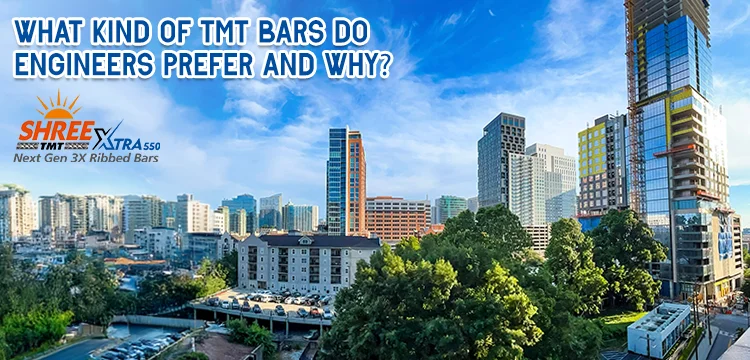
When it comes to the construction of a building intended to be 20, 30, or 50 storeys tall, the margin for error in material selection drops to almost zero. Structural engineers working on high-rise projects are not just looking for strong steel. They are looking for steel that behaves predictably under every kind of stress a building that tall might ever face. This is exactly where the choice of TMT bars becomes critical.
The Core Demand: Strength Without Brittleness
The instinct is to go for the highest grade available, and for high-rise construction, Fe 550D is the go-to choice for most structural engineers. The D designation matters more than the number. It indicates higher ductility, which is the bar’s ability to bend and deform without snapping under load. In a high-rise building, especially in seismic zones, you need steel that absorbs energy rather than transferring a sudden shock directly to the concrete. Brittle steel in a high-rise is a structural liability.
Fe 550D offers a good balance, with adequate tensile strength combined with better elongation values. Fe 550D steps it up further for heavily loaded columns and core walls where both strength and ductility are non-negotiable.
Why Elongation Values Matter in Tall Structures
Most buyers focus on the yield strength number. Engineers focus equally on elongation at fracture. In a high-rise, the lower floors are under sustained compressive and lateral loads from the weight above. If steel in those zones reaches its limit and fractures suddenly, rather than deforming progressively, the result can be catastrophic. Higher elongation gives the structure warning signs, visible deformation before failure, which is exactly what safety codes and good engineering require.
Corrosion Resistance for Long Service Life
It is essential for structural engineers to select TMT Bars that meet the requirements specified for a particular application. For example, structural engineers know that in coastal regions or humid climates, there is increased potential for corrosion of TMT Bars. To combat corrosion, structural engineers require TMT Bars that contain a tempered martensite layer on the outer surface. The tempered martensite layer forms during the thermal treatment process, such as Thermex or Quench-and- Self Temper (QST). A tempered martensite layer creates protection against corrosion, allowing structural engineers to design structures for extended periods of time without concern for premature degradation of the TMT Bars.
Consistency Over Everything
Variations in chemical composition, temperature and rate of cooling create inconsistent properties among TMT Bars. As a result, although some TMT Bars may satisfy minimum property requirements per ASTM standards, these variations in mechanical properties may lead to unpredictable behaviour in actual structures. Due to this variability in mechanical properties, structural engineers now seek to purchase TMT Bars from manufacturers with Quality Control (QC) procedures that verify each lot prior to shipping.
Therefore, for high-rise construction applications, structural engineers prefer Fe 550D grade TMT Bars with confirmed ductility levels and elongation values. Although specifying grade level meets requirements, consistently meeting those specifications throughout all phases of production is significantly more difficult.
Why Shree TMT Is the Preferred Choice for High-Rise Projects
For high-rise construction, the specification always comes down to Fe 550D TMT bars with verified ductility, high elongation values, and consistent batch quality. Meeting those numbers on paper is one thing. Delivering them consistently, across every batch, every season, and every project phase, is another.
At Shree TMT, every bar goes through a controlled rolling and quenching process designed to produce a well-formed tempered martensite outer layer and a tough, ductile core. Our bars carry full mill test certificates, and our manufacturing process ensures traceability from raw material to finished product. Engineers and contractors who have worked with Shree TMT bars across large-scale projects trust them not because of claims, but because the performance shows up in the structure. When the building is very tall, the steel holding it together cannot be an afterthought. That is why Shree TMT remains the choice of builders who refuse to compromise.