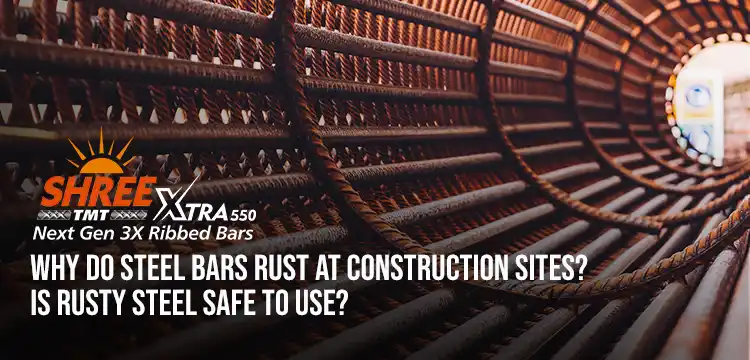
Why Do Steel Bars Rust at Construction Sites? Is Rusty Steel Safe to Use?
Table of Contents:
If you’ve ever stood on a site in August, you’ve probably seen this. The TMT bars that came in looking clean and grey a month ago have turned a shade of orange. The owner sees it, gets worried, and calls the contractor. The contractor says it’s nothing. Both of them are a little bit right.
How the Rusting Starts
Iron does not like being left out in damp air. Give it moisture and oxygen and it begins to oxidise, and that brown layer you see is iron oxide. All steel does this. It does not mean the supplier sent you poor material. Sites just happen to make it very easy. There is never enough space, so bundles get dropped on bare mud. It rains, water pools around them, the sun comes out, and the cycle repeats. If you are building anywhere near the sea, the salt in the air makes it worse. And the bars left standing out of columns, waiting for the next floor, probably have it hardest of all. Sometimes they stand there for a month or more.
Is Rusty Steel Safe to Use?
Mostly, it depends on how deep the rust goes. A light, even brown layer on the surface is common, and most engineers won’t think twice about it. Run your finger over it and very little comes off. Once that bar is inside concrete, the concrete’s alkaline nature actually protects it from rusting further.
Loose rust is another story. If it is flaking or peeling off in bits, it has to be cleaned before concreting, because concrete cannot grip a bar properly through that layer. This bond between steel and concrete is important for reinforcement to perform as intended. . IS 456 also says reinforcement should be free from loose rust and mill scale.
Then there is the kind that has gone beyond the surface. A quick way to check is to scrub a small patch with a wire brush.Clean metal and clear ribs underneath? No problem. But if the surface is pitted or the ribs have worn down, the bar has lost some steel. When you are not sure, cut a metre and weigh it against the standard weight for that size TMT bar weight calculation. . A bar that is too light is too thin, and it will not carry what the design expects it to.
Avoiding the Rust in the First Place
Honestly, most of this comes down to how the steel is stored. A few wooden sleepers under the bundles to keep them off the ground make a big difference. Cover them with a tarpaulin, but do not wrap it tight, because moisture gets trapped and you end up with the exact opposite of what you wanted. Try not to stock up on steel right before the monsoon if you will not be using it for a while. Many site teams coat exposed starter bars with cement slurry until the next pour. And when you do cast, get the cover right. Bars with too little concrete around them are the ones that start corroding years later, when fixing them is a much bigger job.
About the Bars Themselves Storage helps, but the steel has to be good to begin with. Shree TMT’s Fe 550D bars are made to IS 1786 and carry BIS certification, with properly formed ribs and the same quality from one bar to the next. The thermo-mechanical treatment gives them a hard outer layer with a ductile core, which helps them take the knocks of handling and bending on site. They are GreenPro certified too, with a NISST 5-star green steel rating. So keep them dry,keep them off the ground, and you will not have to worry much about that orange tinge.