
High-strength and ductile variants designed for stronger, safer, and future-ready structures
Rib on Rib feature, a product innovation which enhances the steel and cement bonding.
Due to the 3X design, use 9-12% lesser steel and save on your cost of construction.
Withstands stress like no other.
The steel is designed to achieve good UTS/YS Ratio that gives highest elongation.
Distinctive and pioneering TMT Bars unleashing superior strength
#BuildTheXtraordinary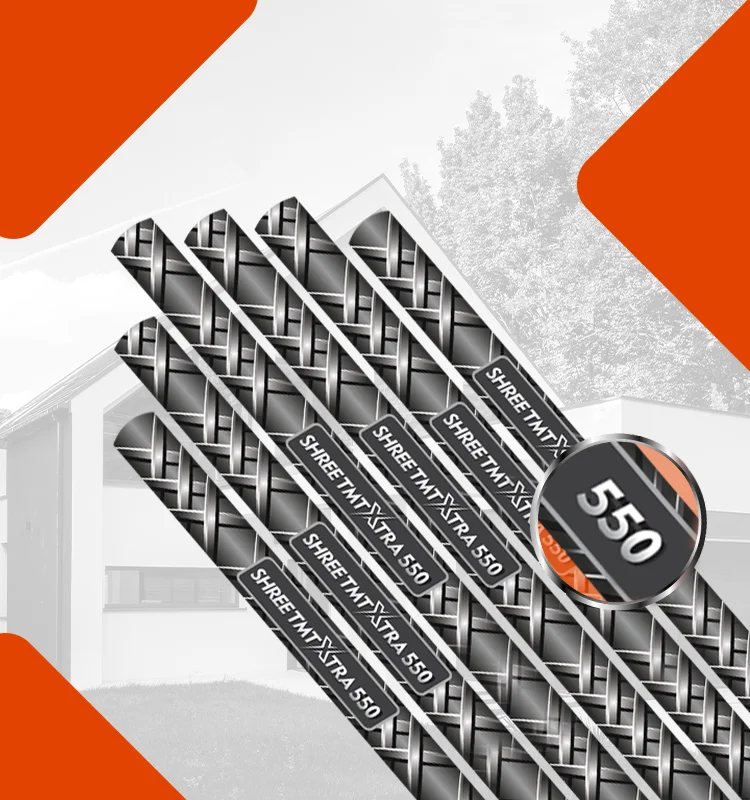
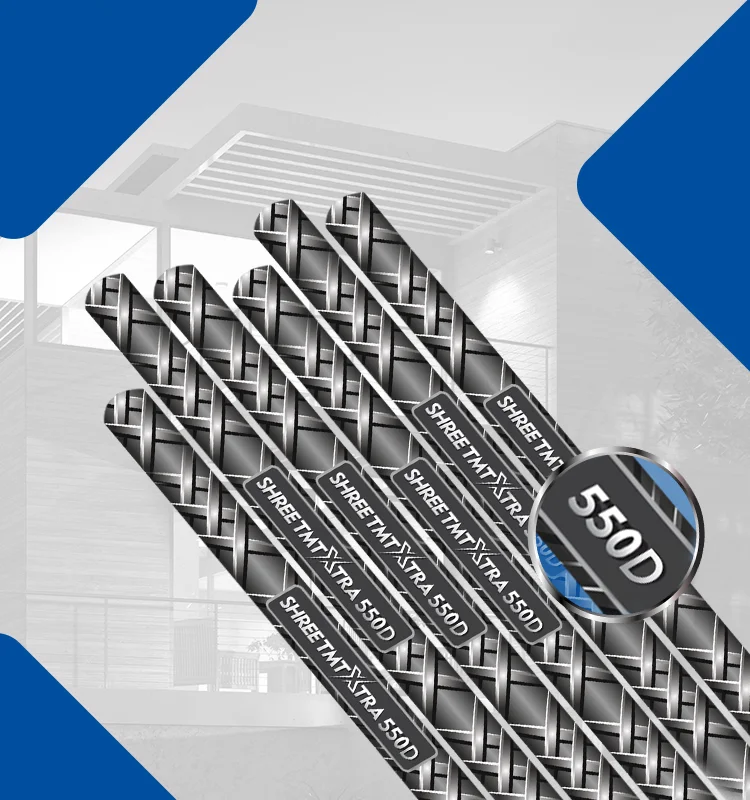
Unleashing enhanced performance with superior ductility.
#BuildTheXtraordinaryUnleashing Xtraordinary corrosion resistance with structural strength.
#BuildTheXtraordinary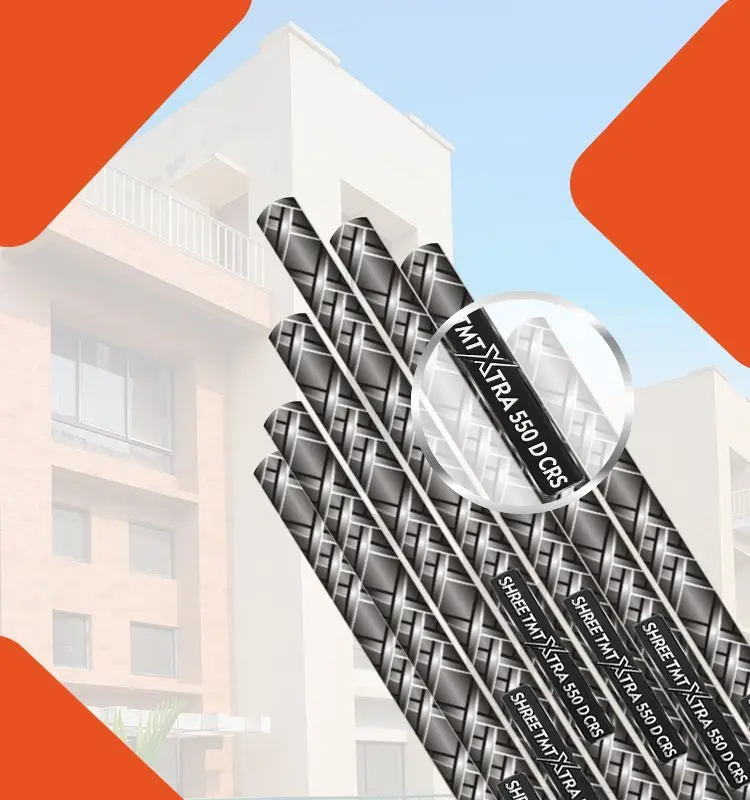
| Mechanical Parameter | BIS Requirement | SHREE Value |
|---|---|---|
| Yield Strength | 550 N/mm² min | 565 N/mm² min |
| Tensile Strength | ≥1.06 x actual YS; ≥585 N/mm² | 650 N/mm² min |
| Elongation | 10.0% min | 16.0% min |
| Total Elongation at Max Force | Not specified | 6.5% min |
| TS/YS Ratio | 1.06 min | 1.15 min |
| Chemical Parameter | BIS Requirement | SHREE Value |
|---|---|---|
| Carbon (C) | 0.30% max | 0.26% max |
| Sulphur (S) | 0.055% max | 0.045% max |
| Phosphorus (P) | 0.055% max | 0.050% max |
| Sulphur + Phosphorus | 0.100% max | 0.095% max |
| Carbon Equivalent (CE) | Not specified | 0.35% max |
| Mechanical Parameter | BIS Requirement | SHREE Value |
|---|---|---|
| Yield Strength | 550 N/mm² min | 565 N/mm² min |
| Tensile Strength | ≥1.08 x actual YS; ≥600 N/mm² | 650 N/mm² min |
| Elongation | 14.5% min | 16.0% min |
| Total Elongation at Max Force | 5.0% min | 6.5% min |
| TS/YS Ratio | 1.08 min | 1.15 min |
| Chemical Parameter | BIS Requirement | SHREE Value |
|---|---|---|
| Carbon (C) | 0.25% max | 0.23% max |
| Sulphur (S) | 0.040% max | 0.035% max |
| Phosphorus (P) | 0.040% max | 0.040% max |
| Sulphur + Phosphorus | 0.075% max | 0.070% max |
| Carbon Equivalent (CE) | 0.61% max | 0.45% max |
| Mechanical Parameter | BIS Requirement | SHREE Value |
|---|---|---|
| Yield Strength | 550 N/mm² min | 565 N/mm² min |
| Tensile Strength | ≥1.08 x actual YS; ≥600 N/mm² | 650 N/mm² min |
| Elongation | 14.5% min | 16.0% min |
| Total Elongation at Max Force | 5.0% min | 6.5% min |
| TS/YS Ratio | 1.08 min | 1.15 min |
| Chemical Parameter | BIS Requirement | SHREE Value |
|---|---|---|
| Carbon (C) | 0.15% max | 0.15% max |
| Sulphur (S) | 0.040% max | 0.035% max |
| Phosphorus (P) | 0.120% max | 0.090% max |
| Silicon (Si) | Not specifically prescribed | 0.25% max |
| Carbon Equivalent (CE) | 0.61% max | 0.45% max |
| Cr + Cu + Ni + Mo + P | ≥0.40% min, subject to BIS proviso* | 0.45% min |
Shree TMT offers high-quality TMT bars in Fe 550 and Fe 550D grades, designed for different construction needs ranging from residential buildings to heavy infrastructure projects.
Fe 550 TMT bars provide a balanced combination of strength and flexibility, making them suitable for residential and commercial construction. Fe 550D TMT bars offer higher tensile strength and improved ductility, making them ideal for high-rise buildings and heavy-load structures.
For house construction, Fe 550 TMT bars are commonly recommended due to their excellent balance of strength, flexibility, and cost-effectiveness. For larger or load-intensive structures, Fe 550D may be preferred.
Shree TMT bars are available in multiple sizes, typically ranging from 8mm to 32mm, suitable for different construction elements such as slabs, beams, and columns.
Shree TMT bars are known for their high strength, superior bonding with concrete due to advanced rib design, corrosion resistance, bendability, and long-term durability, ensuring strong and safe structures.
Yes, especially Fe 550D TMT bars are designed for high-load applications such as high-rise buildings, bridges, and infrastructure projects where superior strength and performance are required.
The choice depends on your construction requirements. Fe 550 is ideal for standard residential and commercial projects, while Fe 550D is better suited for heavy-load structures, high-rise buildings, and projects requiring higher strength and durability.
Yes, due to their high strength and better bonding properties, Shree TMT bars can reduce steel consumption and improve structural efficiency, helping lower overall construction and maintenance costs.
Both offer high strength and ductility. However, SHREE TMT Xtra Fe 550D CRS is specially alloyed with corrosion-resistant elements to provide enhanced protection against rust and corrosion. It combines the strength and ductility of Fe 550D with improved durability in corrosive environments.
Fe 550D CRS is particularly recommended for construction in coastal areas, high-humidity regions, saline environments, and locations exposed to aggressive atmospheric conditions. It is also beneficial for foundations, basements, bridges, and infrastructure projects where corrosion resistance is important.
Yes. CRS bars are corrosion-resistant, not completely rustproof. Minor surface rust or reddish discoloration may occur when exposed to moisture and atmospheric conditions. However, their specialized alloy composition helps slow down the corrosion process compared to conventional TMT bars.
Yes. SHREE TMT Xtra Fe 550D CRS is designed to deliver high strength and ductility while providing additional corrosion resistance. Its specified mechanical properties include a minimum yield strength of 565 N/mm², minimum tensile strength of 650 N/mm², minimum TS/YS ratio of 1.15, and minimum elongation of 16%.
Yes. CRS bars provide an additional level of protection, particularly for homes in coastal, high-moisture, or corrosion-prone environments. They help reduce the risk of reinforcement corrosion and contribute to improved long-term durability of the structure.
When reinforcement steel corrodes, rust formation can cause the steel to expand, leading to cracks, concrete spalling, and deterioration over time. Corrosion-resistant TMT bars help slow this process, protecting the reinforcement and improving the durability of reinforced concrete structures.
CRS TMT bars can contribute to a longer structural service life by reducing the rate of reinforcement corrosion. This helps minimize corrosion-related deterioration and potential maintenance costs, particularly in aggressive environments. Overall structural longevity also depends on proper design, concrete quality, and construction practices.