How Many Bricks Are Required for 1 Square Foot?
Table of Contents:
Anyone who has built a house knows the moment. The contractor sends across an estimate, and somewhere between the cement bags and sand loads lies a stack of bricks running into thousands. Some get used, and some go to waste. Most homeowners accept it and move on. A few quietly wonder whether they are paying for more than the walls will ever use.
You don’t need an engineering degree to check that number. Once you know roughly how many bricks go into a single square foot of wall, the rest is simple multiplication.
Start With the Brick Itself
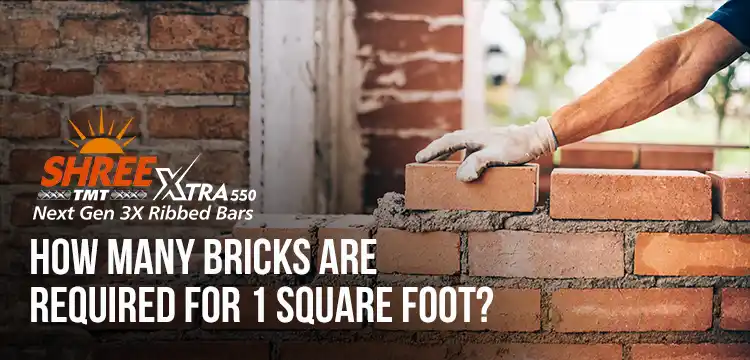
In India, you will mostly come across two common types of brick sizes. The modular brick measures 190 x 90 x 90 mm. Many local kilns still make the older conventional brick, roughly 230 x 110 x 75 mm, which masons usually refer to as a 9 x 4.5 x 3 inch brick.
What people tend to overlook is the mortar. Each joint adds about 10 mm, so a brick on the wall occupies more space than it does lying on the ground. That is why the count per square foot comes out lower than a quick calculation on the brick alone would suggest.
The Number Depends on Wall Thickness
A partition wall between two rooms is usually 4.5 inches thick, which is a single brick laid lengthwise. Outer walls and walls that take load are usually 9 inches, or two bricks side by side. Site engineers generally work with these figures:
| Wall type | Typical use | Bricks per sq ft |
| 4.5-inch (half brick) | Internal partitions | About 4.5 to 5 |
| 9-inch (full brick) | External and load-bearing walls | About 9 to 10 |
Treat both as rounded working numbers. The brick size and joint thickness on your site will nudge them slightly either way.
Let’s Try It on a Real Wall
Consider the outer wall of a bedroom, 12 feet long and 10 feet high. On paper, that is 120 sq ft. It has a 4 x 4 ft window, though, so 16 sq ft comes off, leaving 104 sq ft of actual brickwork.
At about 9 bricks per sq ft for a 9-inch wall, you get 936 bricks. Every site loses a few to breakage and cutting, so most builders add around 5%, which takes you close to 980. One wall, nearly a thousand bricks. Work through each room the same way, and the figure on your estimate becomes much easier to judge.
Why Your Count May Differ
A few practical things shift the final number. Thicker mortar joints in brickwork use slightly fewer bricks but more cement and sand. Poorly burnt or uneven bricks crack more often during handling, so wastage climbs. Doors, windows and ventilators need to be subtracted before you multiply, and it is surprisingly easy to forget the smaller openings. Brick sizes also vary from kiln to kiln, so measuring a few pieces from your supplier before a bulk order is time well spent.
All of this gives you a reliable planning estimate. The final quantity should still come from your structural drawings and your engineer.
What Really Holds Your Home Up
Most homes built today use an RCC frame structure. In this kind of structure, the brick walls are largely infill. They divide rooms and keep out the weather, while the weight of slabs and floors travels through beams and columns down to the foundation.
That frame depends on the TMT bars cast inside it. When the ground shakes, or the building takes a load nobody planned for, the steel is what has to hold, to keep the structure together. Fe 550D bars are valued for exactly this mix of high strength and ductility, which lets them stretch and absorb stress rather than fail suddenly.
A Strong Home Starts With the Right Steel
A rough brick count helps you plan your budget, cut down on leftover material and have a better-informed conversation with your contractor. It is a small piece of homework that pays for itself.
The walls, however, are only as dependable as the frame around them. Shree TMT’s Fe 550D bars are manufactured to IS 1786 and carry BIS certification, giving your structure the strength and flexibility it needs for decades. They are also GreenPro certified with a NISST 5-star green steel rating, so building strong doesn’t have to come at the planet’s expense. Count your bricks, by all means. Then make sure the steel holding everything together is Shree TMT.