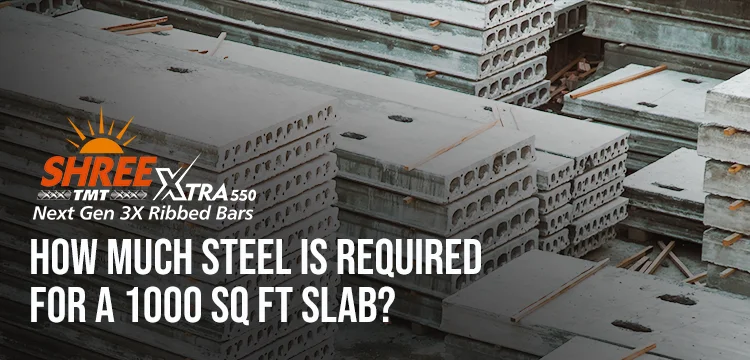
How Much Steel Is Required for a 1000 Sq Ft Slab?
Table of Contents:
Ask any site engineer how much steel a 1000 sq ft slab needs, and you’ll get two very different kinds of answers depending on how much time they have for you. One is a quick number thrown out on site. The other is an actual worked out figure. Neither is wrong exactly, they’re just answering different questions, and it helps to know which one you’re really asking for before you place an order for TMT bars.
The Number Everyone Quotes (And Why It’s Slightly Off)
Walk onto almost any residential site in India and ask this, and someone will say “4 kg per square foot” within about five seconds. It’s not a made up figure either, that 3.5 to 4.5 kg/sq ft range is a real planning number. But it usually refers to the entire RCC structure, footing, columns, beams, and slab put together, not the slab on its own. Apply it only to the slab and you’ll end up ordering far more steel than the job needs.
For the slab alone, there’s a more grounded estimation rule commonly used for planning and procurement.
A Practical Estimation Rule for Slabs
Steel in a slab is often estimated at around 1% of the volume of concrete (some use figures as low as 0.7%, depending on span and load). It’s worth being upfront about what this is: a thumb rule for early quantity take-off, not a design requirement. IS 456 doesn’t prescribe 1% anywhere. The code only sets a minimum reinforcement of 0.12% of the cross-sectional area for HYSD bars like Fe 415 or Fe 500 (0.15% for mild steel), mainly to control shrinkage and temperature cracking. The actual percentage in a designed slab is worked out from span, load, and thickness through structural calculations, and for typical residential spans it usually lands somewhere between 0.2% and 0.5%, well under the 1% used here for estimation. The 1% figure simply builds in enough margin that a material order doesn’t fall short.
Steel weighs 7,850 kg per cubic metre, so this estimation shortcut works out to:
Steel Quantity (kg) ≈ Volume of Concrete (m³) × 78.5
Volume of concrete, in turn, is just area multiplied by thickness. This gives you a workable number to plan and order against. The reinforcement percentage that actually goes into the drawing is always your structural engineer’s call, not this rule of thumb.
Running the Numbers for 1000 Sq Ft
1000 sq ft works out to roughly 92.9 sq m. Thickness is where the real variation comes from, so rather than picking one number, here’s how it plays out across the thicknesses you’d actually see on a residential or light commercial job.
| Slab Thickness | Steel Rate (kg/sq ft) | Steel Required (1000 sq ft) |
|---|---|---|
| 100 mm (4″) | 0.73 kg/sq ft | ~730 kg |
| 115 mm | 0.84 kg/sq ft | ~840 kg |
| 125 mm (5″) | 0.91 kg/sq ft | ~910 kg |
| 140 mm | 1.02 kg/sq ft | ~1,020 kg |
| 150 mm (6″) | 1.09 kg/sq ft | ~1,095 kg |
Most residential slabs settle around 125 mm, which puts you at roughly 0.9 kg/sq ft, or 900 to 950 kg of steel for 1000 sq ft. Add another 5 to 8% on top for cutting waste and lap lengths at joints, and your actual procurement figure lands close to a full tonne.
What Actually Moves This Number
Thickness has the biggest pull, but it isn’t the only variable. A two way slab, one spanning in both directions, needs noticeably more reinforcement than a one way slab of the same footprint. Bar diameter matters too. Go with 8mm bars instead of 10 or 12mm and you’ll place more bars closer together to hit the same steel percentage, which changes labour and handling on site even when the total weight comes out similar. Support conditions, concrete cover, and any openings for stairwells or ducts pull the number around a bit as well.
None of this replaces an actual bar bending schedule from your structural engineer, worked out under IS 456. The chart above is a planning and procurement estimate, not a design output.
Getting the Steel Right
Once you have a rough quantity in hand, the next question is what you’re actually buying. Fe 550D bars, manufactured to IS 1786 and BIS specifications, give slabs the ductility they need to handle load redistribution without failing suddenly. That’s the standard Shree TMT bars are made to, batch after batch, so your site engineer isn’t second guessing tolerances halfway through a pour.