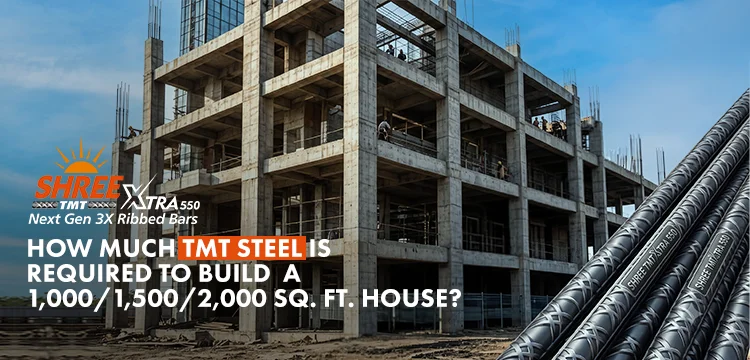
How Much TMT Steel Is Required to Build a 1,000 / 1,500 / 2,000 Sq. Ft. House?
Table of Contents:
Before the foundation work even starts, most homeowners want a number: how much steel will this house actually take? It’s a fair thing to ask early. Steel is one of the higher costs in any build, and a rough figure at the planning stage keeps you from overordering, or worse, running short halfway through.
There’s no single answer that fits the requirements of every house. The real number depends on how many floors you’re adding, the seismic zone you’re in, the soil where the construction is taking place, and whatever your structural engineer finalises. But as a starting point, the industry typically works with 3.5 to 4.5 kg of TMT steel per square foot of built-up area. It’s a planning shortcut, not a replacement for your engineer’s actual calculations.
Applied to common house sizes, that works out to roughly:
- 1,000 sq. ft.: 3,500 to 4,500 kg (3.5 to 4.5 tonnes)
- 1,500 sq. ft.: 5,250 to 6,750 kg (5.25 to 6.75 tonnes)
- 2,000 sq. ft.: 7,000 to 9,000 kg (7 to 9 tonnes)
A single storey house tends to land near the lower end. Add a floor or two, or build in a higher seismic zone, and you drift toward the top of the range.
Where does all this steel actually go?
It’s not concentrated in one place. TMT bars show up almost everywhere something is holding weight: in the footings that anchor the house to the ground, the plinth beams tying the foundation together, the columns carrying every floor’s load downward, and the beams that hold the slabs up. You’ll also find them reinforcing the roof and floor slabs in a grid, running through lintels above doors and windows, and inside staircases that take a beating year after year.
Given how spread out that is, the strength of the steel isn’t some technical detail you can skim over. It’s woven into almost every part of the house that’s actually holding it up.
Why the strength of your TMT bars actually matters
Here’s the thing: your engineer can get the quantity exactly right, and it still won’t matter much if the bars themselves are inconsistent. Weak elongation, uneven yield strength, poor corrosion resistance, any of these can undo good design work. So, the quality of the steel you buy carries just as much weight as how much of it you order. Decades of load, moisture, and seismic activity all rest on that steel holding up the way it’s supposed to. Skimping here to save a bit per bag is rarely worth it once you consider what’s actually riding on it.
How Shree TMT bars hold up
Our Fe 550D bars are built with exactly this in mind. Compared to standard Fe 500 bars, Fe 550D has a higher ductility rating, so it can flex and absorb stress instead of snapping outright, useful in any region where seismic activity is a real concern. Every batch we produce is manufactured to IS 1786 specifications and tested for consistency, so what you get in your hundredth delivery matches what you got in your first. We’re also GreenPro certified, carry a NISST 5-star green steel rating, and sit on the Indian Green Building Council, so the steel itself checks both structural and environmental boxes.
Before placing your order, get a proper bar bending schedule from your structural engineer, and pick a brand that can back its claims with IS 1786 test data and BIS compliance. It’s one of those decisions that disappears the moment the plaster goes on, which is exactly why it’s worth getting right before it does.