Why Structural Design Is the Real Secret Behind Strong Buildings and Why TMT Bars Matter
Table of Contents:
Every multi-storey building you see standing through monsoons, tremors, and decades of daily use owes its survival not just to bricks and concrete but to the invisible engineering decisions made long before the first column was poured. Structural design is where a building’s strength is truly born, and the reinforcement steel chosen at this stage determines whether that strength lasts five years or fifty.
Here’s how structural design shapes the strength of modern buildings and why Fe 550D TMT bars have become the reinforcement of choice for engineers and builders across India.
How Structural Design Distributes Load in a Building
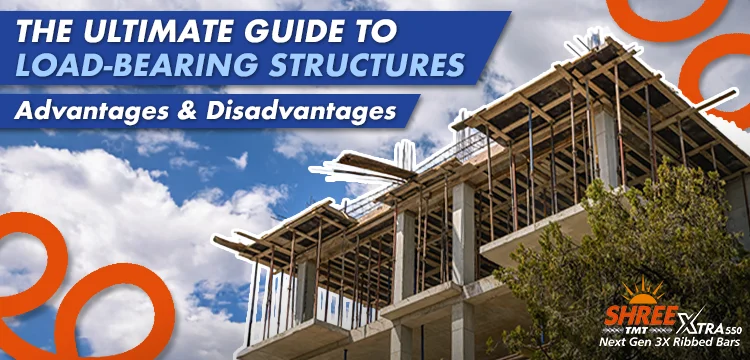
At its core, structural design is about managing forces. Every building must handle two types of loads: dead loads (the self-weight of slabs, beams, walls, and columns) and live loads (people, furniture, vehicles, wind, and seismic forces). A structural engineer’s job is to design a load path a continuous route through which these forces travel from the topmost slab, through beams and columns, down into the foundation, and safely into the ground.
When the load path is well-designed, forces are distributed evenly. No single element is overburdened. The building remains stable, crack-free, and serviceable for its intended lifespan. But when the design is flawed or the materials used can’t handle the calculated stresses the consequences range from hairline cracks in walls to catastrophic structural failure.
This is precisely why the choice of reinforcement steel is not a secondary decision. It’s central to structural design itself.
Why Concrete Alone Is Not Enough
Concrete is exceptional at handling compressive forces it can bear enormous weight pushing down on it. But it performs poorly under tension, the pulling and stretching forces caused by bending, wind pressure, or seismic movement. That’s why every modern RCC (Reinforced Cement Concrete) structure relies on steel reinforcement bars embedded within the concrete. The steel resists tension while the concrete resists compression, and together they form a composite system far stronger than either material on its own.
The quality of the steel used its yield strength, ductility, bonding capacity, and resistance to corrosion directly determines how well that composite system performs under real-world conditions.
What Makes Fe 550D TMT Bars the Preferred Choice for Modern Construction
Fe 550D TMT (Thermo-Mechanically Treated) bars are engineered for the structural demands of today’s construction projects. Their manufacturing process controlled heating followed by rapid water quenching produces a unique dual structure: a tough, high-strength outer martensite layer and a softer, ductile inner ferrite-pearlite core. This combination delivers a set of properties that directly support sound structural design.
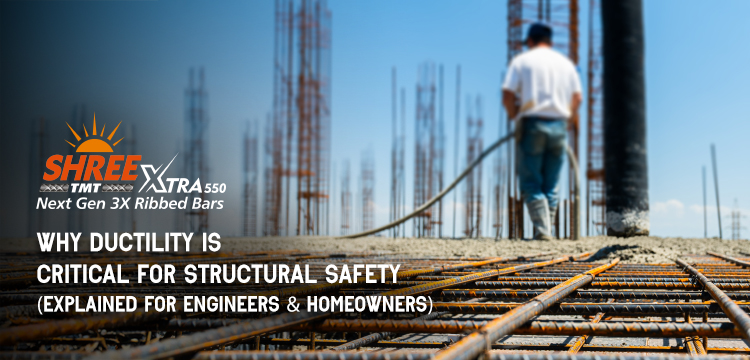
Fe 550D bars handle heavy loads across high-rise residential towers, commercial complexes, bridges, flyovers, and industrial structures. The “D” in Fe 550D stands for enhanced ductility these bars can elongate up to 16% without breaking, which means they absorb seismic energy during earthquakes rather than snapping under stress. This makes them ideal for construction in earthquake-prone zones across India.
Their ribbed surface profile creates a strong mechanical bond with concrete, ensuring the steel and concrete work as a single cohesive unit. And their low carbon, sulphur, and phosphorus content provides superior corrosion resistance critical for structures in coastal, humid, or chemically aggressive environments.
In practical terms, using Fe 550D can also reduce overall steel consumption by 15–20% compared to lower grades, leading to lighter structures, lower material costs, and reduced construction timelines without compromising structural safety.
Build with Confidence Build with Shree TMT
At Shree TMT, our Fe 550D TMT bars are manufactured in strict compliance with IS 1786:2008, the Bureau of Indian Standards specification for high-strength deformed steel bars and wires for concrete reinforcement. Every batch meets the mandated requirements for yield strength, tensile strength, elongation, and chemical composition ensuring that the bars you use on site perform exactly as your structural engineer designed them to.
With decades of expertise in steel manufacturing and an unwavering commitment to BIS-certified quality, Shree TMT has been the trusted reinforcement partner for builders and engineers across India. Because a structure’s real strength isn’t just drawn on blueprints it’s forged in the steel that holds everything together.
Tags: tmt, TMT bar calculation benefits, TMT bar calculator, tmt bars, tmt bars benefits, tmt bars in construction